


Views: 0 Author: Site Editor Publish Time: 2025-10-24 Origin: Site


Industrial facilities can choose from a range of waste gas treatment technologies to control emissions and meet strict environmental regulations. The main options include wet scrubbers, dry filters, packed towers, adsorption‑desorption systems, VOC concentrators, regenerative thermal oxidation (RTO/RCO), biological methods, catalytic oxidation, and hybrid systems.
Each technology targets specific pollutants and operating conditions. Understanding how they work and where they perform best helps you design an efficient, compliant, and cost‑effective solution instead of relying on trial and error.
Wet scrubbers use a liquid, usually water or a chemical solution, to capture pollutants from waste gas. The liquid is sprayed or distributed into the gas stream so that pollutants are absorbed or chemically neutralized. Wet scrubbers are particularly effective for acid gases such as SO₂, HCl, and HF, as well as for dust and fine particles. They are widely used in power plants, chemical factories, cement plants, metal refineries, and pharmaceutical production.
Key advantages of wet scrubbers include simultaneous removal of particulate and gaseous pollutants, good performance with wet or saturated gas streams, and relatively compact equipment size. Under proper design, wet scrubbers can remove more than 95% of dust and achieve very high acid gas removal efficiencies.
Typical performance of different wet scrubber types is shown below.
| Scrubber Type | Gas Removal (%) | Dust Removal (%) |
|---|---|---|
| Packed Bed | 95–99.9 | 10–30 |
| Venturi | 30–60 | 90–99.9 |
| Spray Tower | 60–85 | 70–90 |
| Tray Tower | 85–95 | 20–40 |
| Dual‑Stage | 99+ | 95+ |
We design and supply high‑efficiency wet scrubber systems at Shandong Eco Nova Group. Our scrubbers are engineered for stable performance, low pressure drop, and long service life. We hold over 20 product patents in waste gas treatment and have been recognized by the China Environmental Protection Association and other industry bodies, demonstrating that our solutions meet top industry standards.
Dry filters remove particles and certain combined pollutants using solid filter media. Common options include fabric filters (baghouses), ceramic filters, and ceramic filter candles. Fabric filters are widely applied for dust control in industrial plants and offer high efficiency with reasonable cost. Ceramic filters and candles withstand very high temperatures, strong chemical environments, and are used where conditions are too harsh for conventional fabrics, for example in petrochemical processes or hazardous waste incineration.
Dry filters are preferred where water cannot be used or would create handling problems, such as in cement plants and high‑temperature processes. When selecting a dry filtration system, you should consider not only the equipment price but also the total cost of ownership, including energy use from pressure drop, filter replacement, and downtime.
At Eco Nova, we design dry filter systems to reduce overall lifecycle costs. By choosing suitable filter materials and optimizing system design, we help our customers meet strict emission limits while controlling operating expenses.
Packed towers are a type of wet scrubber that use a packed bed to increase the contact area between gas and liquid. Scrubbing liquid flows downward over the packing while the gas moves upward, creating intensive mass transfer. The packing has a large surface area and high void fraction, which promotes efficient absorption with moderate pressure drop.
Packed towers are well suited for removing water‑soluble VOCs and acid gases such as HF, HCl, Cl₂, SO₂, and NH₃. Performance can be improved by adjusting gas and liquid flows, temperature, packing type, and operating pressure. For example, in semiconductor fabrication, packed bed scrubbers can remove up to about 98.9% of HF, HCl, and Cl₂.
| Industry | Pollutant | Scrubber Type | Efficiency (%) |
|---|---|---|---|
| Power Plant | SO₂ | Wet lime scrubber | 97.5 |
| Semiconductor | HF, HCl, Cl₂ | Packed bed wet scrubber | 98.9 |
| Fertilizer Plant | NH₃ | Dual‑stage acid scrubber | 95.3 |
| Incineration | Dioxins & dust | Venturi + packed tower | 99.9 |
Our packed tower scrubbers are designed for reliable, continuous operation and high mass‑transfer efficiency. We supply systems that meet stringent environmental regulations, and many large companies in the power, chemical, and manufacturing sectors rely on our packed tower technology.
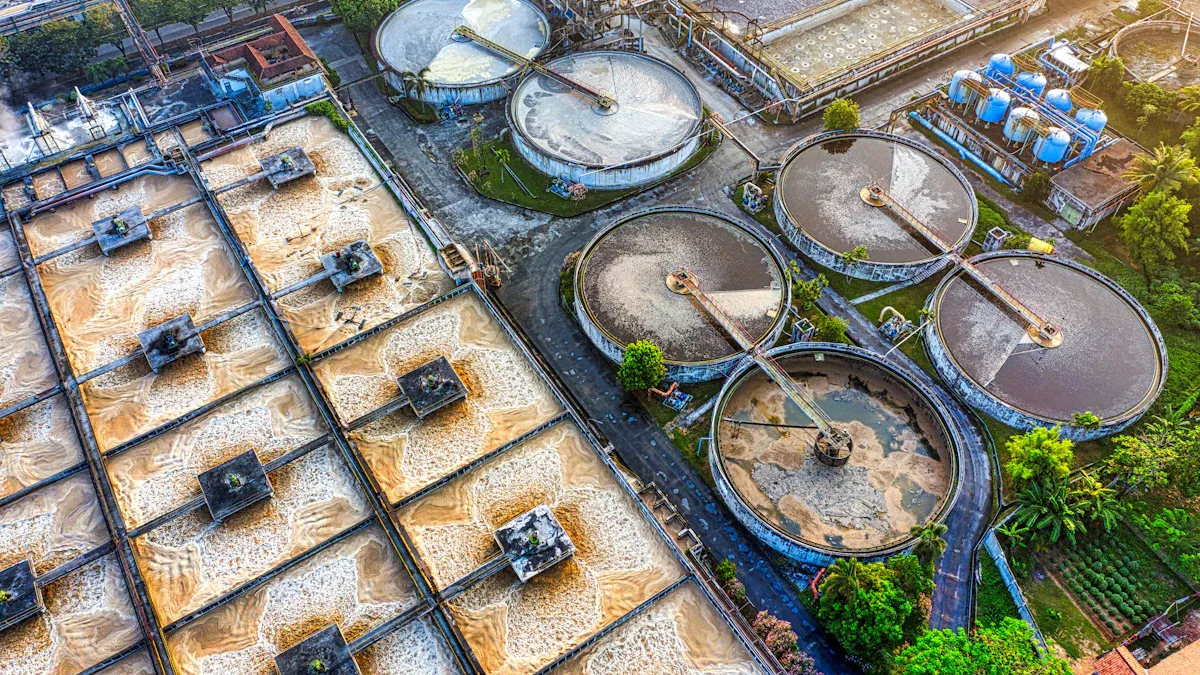
Adsorption‑desorption systems remove organic waste gases and some inorganic pollutants by binding them to solid adsorbent surfaces. When the adsorbent becomes saturated, temperature or pressure is changed to release the captured pollutants, which are then treated or recovered.
New developments include multi‑layer beds for higher CO₂ capture, zeolite molecular sieves and metal‑organic frameworks (MOFs) that perform well under changing humidity, and vacuum pressure swing adsorption for high‑purity CO₂ recovery. New adsorbent materials such as organic polymers and biochar offer better selectivity and longer service life.
Adsorption‑desorption systems are widely used for VOCs and NOx, often combined with catalytic oxidation. This combination allows high removal efficiency while reducing energy use by recovering and concentrating pollutants before final destruction.
VOC concentrators and zeolite rotors are used for large‑volume, low‑concentration organic waste gas streams. These systems adsorb VOCs from the main airflow onto a rotating wheel or bed and then desorb them into a much smaller hot air stream. The resulting concentrated gas is sent to thermal or catalytic oxidation.
Typical benefits include lower operating costs and significantly reduced fuel consumption. In practice, plants can achieve up to around 40% energy savings compared with direct thermal oxidation of dilute VOC streams. VOC concentrators are commonly applied in chemical, petrochemical, pharmaceutical, food, and coating industries, and are designed to meet standards such as ISO14001, EPA requirements, and EU BAT guidance.
We integrate zeolite rotors and VOC concentrators with RTO or catalytic oxidizers to help customers achieve high VOC destruction rates, stable emissions, and lower energy use.
Regenerative thermal oxidizers (RTO) and regenerative catalytic oxidizers (RCO) are powerful solutions for treating organic waste gas and high‑concentration VOCs. They use ceramic heat‑exchange media to recover heat from treated gas and preheat incoming polluted air. Operating temperatures are typically around 1500°F or higher to ensure near‑complete oxidation of organic compounds.
With proper design, RTO/RCO systems can achieve VOC removal rates above 99% and thermal efficiencies up to about 95–97%. This combination of high destruction efficiency and heat recovery reduces fuel consumption and total lifecycle cost, especially for higher VOC loadings.
Relevant regulatory frameworks include the Clean Air Act, EPA emission standards, OSHA safety requirements, and NESHAP for hazardous air pollutants. Our RTO/RCO systems at Shandong Eco Nova Group are engineered to comply with these and comparable international standards. We focus on energy recovery, system reliability, and safety so your facility can meet strict emission limits with predictable operating costs.
Biofilters and biotrickling filters use microorganisms to degrade pollutants in a biofilm on a packed bed. Pollutants transfer from the gas phase into the biofilm, where they are biologically broken down. In biotrickling filters, a recirculating liquid continuously passes over the packing to supply nutrients, control pH, and remove by‑products.
These systems are especially suitable for odor control and low‑to‑medium concentration gases, including ammonia and some VOCs. They are used in waste treatment plants, landfills, composting sites, metallurgical processes, wastewater treatment plants, and various industrial odor sources.
Advantages include good resistance to fluctuating loads, no hazardous liquid effluent when correctly designed, and relatively low investment and operating costs. We support customers from process design through to intelligent control and remote monitoring to ensure stable performance with simple operation.
Catalytic oxidation uses catalysts to accelerate the breakdown of VOCs and hazardous gases at lower temperatures than non‑catalytic thermal oxidation. Typical operating temperatures are about 500–650°F, which significantly reduces fuel consumption. Catalytic oxidizers offer high destruction efficiency for suitable VOC streams, especially where concentrations are low to medium and halogenated compounds are limited.
In many projects, catalytic oxidation is combined with upstream adsorption or VOC concentration to reduce energy use and improve overall removal efficiency.
Hybrid waste gas treatment systems integrate physical, chemical, biological, and thermal processes into a single solution. Combinations can include absorption, adsorption, catalytic oxidation, plasma and photocatalytic oxidation, and biological treatment steps.
Hybrid systems are particularly valuable when multiple pollutant types must be treated simultaneously, when emission limits are extremely strict, or when there is an opportunity to convert waste gas into usable energy. With smart controls and remote monitoring, hybrid systems can maintain high removal efficiency, optimize power coverage, and improve project profitability, while still being manageable in day‑to‑day operation.
Choosing the best technology depends on the type and concentration of pollutants, required removal efficiency, energy consumption, and total lifecycle cost. You should also consider space, maintenance needs, operator skills, and integration with existing process equipment. Certifications such as ISO14001, and compliance with EPA or EU BAT standards, indicate that the system is designed to support regulatory compliance.
By working with an experienced technology provider, you can match wet scrubbers, dry filters, packed towers, advanced VOC controls, and biological or hybrid solutions to your specific process. At Shandong Eco Nova Group, we focus on high efficiency, energy saving, and reliable operation, helping you meet environmental regulations while controlling costs and supporting sustainable growth.


