


Views: 0 Author: Site Editor Publish Time: 2026-09-16 Origin: Site


Facility managers face a constant, high-stakes balancing act every single day. You must protect worker health against strict occupational exposure limits. At the same time, you need flawless environmental compliance to meet regional emission standards. Missing the mark on either front carries severe operational consequences. Fluctuating VOC concentrations create dangerous blind spots in your safety protocols. These fluctuations also destroy equipment efficiency. Over-engineering a mitigation strategy wastes valuable engineering resources. Conversely, under-engineering leaves your facility vulnerable to sudden shutdowns and heavy regulatory fines.
We provide a transparent, evidence-based framework for evaluating baseline workshop emissions. You will learn how to select the right industrial VOC treatment systems for your unique environment. By tracking precise airflow data, you can build a safer, more robust operational plan. This article explores exact methodologies for monitoring emissions and matching treatment technologies to your specific chemical profile.
Baseline **VOC concentrations** and exhaust airflow volumes are the absolute determiners of your treatment technology strategy.
Direct destruction via RTO is highly efficient for high-concentration/low-volume streams but operationally cost-prohibitive for low-concentration/high-volume scenarios.
Implementing a **VOC Concentrator** upstream of an RTO drastically reduces natural gas consumption and operational expenditure (OPEX) for large-volume workshops.
Continuous, multi-point monitoring is required to manage Lower Explosive Limit (LEL) risks and ensure abatement equipment operates within its designed thermal thresholds.
Industrial facilities must distinguish between occupational safety limits and environmental emission thresholds. They serve entirely different purposes. Worker exposure limits focus on the breathing zone inside your workshop. Agencies define these as Time-Weighted Averages (TWA) or Permissible Exposure Limits (PEL). They measure how much solvent vapor a human can safely inhale over an eight-hour shift. Environmental thresholds focus on the exhaust stack. They dictate the necessary destruction efficiency before emitting air into the atmosphere. You must satisfy both frameworks to operate legally.
Managing the Lower Explosive Limit (LEL) forms the backbone of industrial safety. Standards mandated by organizations like the NFPA require strict oversight of ductwork environments. You must keep VOC concentrations safely below 25% of the LEL inside your ducting. Exceeding this threshold introduces catastrophic fire and explosion risks. Vapors can ignite easily if a spark occurs within the exhaust network. Safety protocols demand aggressive monitoring to prevent localized solvent pooling.
Many facilities still rely on periodic spot-checks. This approach creates a massive data gap. Spot-checks fail to capture sudden concentration spikes during intensive production runs. They give a false sense of security. Continuous Emission Monitoring Systems (CEMS) eliminate this blind spot. Real-time visibility ensures you never guess about the safety of your exhaust stream. You can address hazardous peaks immediately rather than discovering them after an incident.
Building a robust monitoring architecture requires choosing the right detection technology. Engineers typically evaluate Photoionization Detectors (PID) against Flame Ionization Detectors (FID). A PID uses ultraviolet light to ionize gas molecules. It offers excellent sensitivity for aromatic compounds. However, humidity can sometimes interfere with PID accuracy. An FID uses a hydrogen flame to burn the sample gas. It counts carbon atoms directly. FID provides a highly accurate, reliable baseline for nearly all hydrocarbons. Most heavy industrial settings prefer FID for compliance-grade monitoring.
Continuous Monitoring Technology Comparison: PID vs. FID
Technology | Detection Method | Target Gases | Accuracy Factors | Best Use Case |
|---|---|---|---|---|
PID | Ultraviolet Light | Aromatics, Ketones | Sensitive to high humidity levels | Breathing zones, quick spot-checks |
FID | Hydrogen Flame | Most Hydrocarbons | Highly stable, unaffected by moisture | Exhaust stacks, continuous LEL tracking |
Mapping your workshop correctly ensures you capture usable data. Sensor placement directly influences your safety outcomes. You should deploy sensors strategically across three distinct zones:
Breathing Zones: Place ambient sensors near operator workstations. These track immediate TWA exposure risks for your personnel.
Emission Source Capture: Install monitors inside paint hoods or mixing enclosures. This captures the highest concentration spikes before dilution.
Exhaust Stacks: Position compliance-grade FID sensors at the final emission point. This verifies the performance of your abatement equipment.
System integration transforms raw data into actionable safety protocols. Real-time data must feed directly into programmable logic controllers (PLCs). The PLC acts as the brain of your exhaust infrastructure. When VOC concentrations spike dangerously high, the PLC takes immediate action. It can automatically ramp up exhaust fan speeds to dilute the stream. If levels approach the 25% LEL threshold, the PLC triggers bypass valves. This diverts explosive mixtures away from high-heat abatement equipment, preventing catastrophic ignition.
High-volume, low-concentration streams present a unique engineering challenge. Paint booths and semiconductor cleanrooms typically generate massive airflow. However, the actual solvent volume remains quite low. Pushing 100,000 cubic feet per minute of mostly clean air into a burner wastes enormous amounts of energy. The air requires massive energy to reach combustion temperatures. This scenario demands a specialized approach to avoid extreme inefficiency.
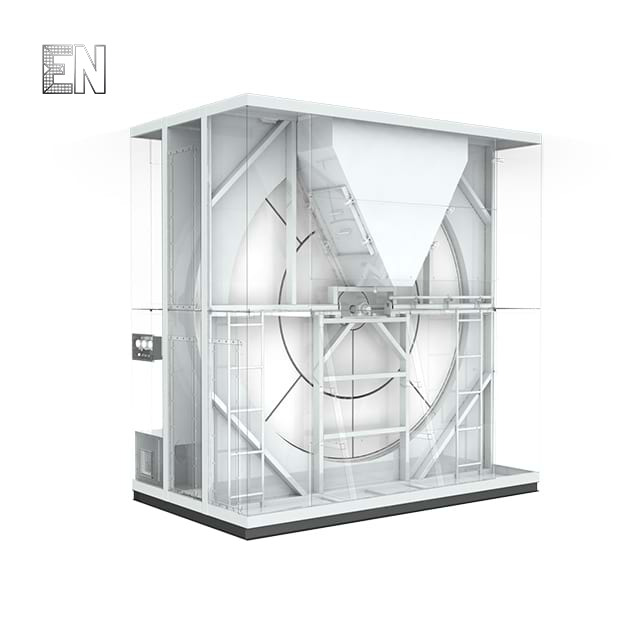
The solution involves introducing a VOC Concentrator into your process line. We typically use a rotating zeolite wheel for this application. The high-volume exhaust passes through the porous zeolite structure. The media adsorbs the solvent molecules while letting clean air vent outside. A separate, much smaller stream of hot air then desorbs the trapped solvents. You evaluate success based on the concentration ratio. Achieving a 10:1 or 20:1 ratio drastically reduces the required size of your downstream equipment. It makes the entire process highly efficient.
High-concentration scenarios require a different strategy. Chemical processing or heavy printing applications often produce exhaust streams rich in solvents. For these environments, you route the exhaust directly to a RTO. The thermal oxidizer uses ceramic media to recover heat and destroy pollutants at temperatures exceeding 1,500°F.
Success in high-concentration environments relies on thermal efficiency. You want to reach a state called auto-thermal operation. At this point, the VOC concentrations provide enough fuel to sustain combustion independently. The RTO no longer requires supplemental natural gas to maintain its internal temperature. Achieving auto-thermal operation represents the peak of thermal efficiency. It ensures your abatement process remains environmentally sustainable and highly effective.
Combining a concentrator wheel with a thermal oxidizer creates powerful system synergy. This hybrid approach perfectly solves the high-volume/low-concentration dilemma. The wheel acts as a filter and aggregator. It takes a massive, dilute airstream and shrinks it down into a dense, manageable fuel source. You then send this small, rich stream to the oxidizer. The oxidizer can now operate in its ideal auto-thermal state. You get maximum destruction efficiency without heating empty air.
However, implementation carries specific engineering risks. You must protect the zeolite rotor from contamination. Particulate matter will quickly blind the microscopic pores of the zeolite. Pre-filtration requirements are absolutely non-negotiable. You must install multi-stage particulate filters upstream. Humidity also impacts adsorption capacity. High moisture levels compete with solvents for space inside the zeolite pores. Furthermore, high-boiling-point VOCs can cause permanent rotor fouling. These heavy compounds refuse to desorb during the heating cycle, slowly killing the wheel's capacity.
Maintenance realities dictate the long-term success of this hybrid system. You need a transparent breakdown of ongoing expectations. Maintenance crews must follow strict schedules to prevent downtime.
Media Replacement Cycles: Ceramic heat exchange blocks may last a decade, but pre-filters require monthly checks.
Valve Seat Inspections: Poppet valves inside the oxidizer cycle thousands of times a day. You must inspect their seals quarterly to prevent untreated gas leaks.
Bake-Out Procedures: You must periodically run high-temperature bake-out cycles on the concentrator wheel. This aggressive heating process burns off stubborn, high-boiling-point residues.
Selecting an equipment vendor requires strict engineering scrutiny. You cannot buy industrial abatement systems off the shelf. Every facility presents a unique chemical footprint. Your chosen partner must demonstrate deep expertise in thermodynamics and airflows. Moving forward blindly leads to mismatched equipment and chronic process interruptions. You need a vendor who prioritizes custom engineering over generic solutions.
Use rigorous evaluation criteria when shortlisting potential vendors. Focus on their technical methodology and support infrastructure. Ask the following critical questions:
Does the vendor offer a preliminary engineering study based strictly on your historical emissions data?
Do they provide guaranteed Destruction and Removal Efficiency (DRE) metrics under variable factory load conditions?
Can they prove the availability of localized support and rapid spare parts delivery for critical components like poppet valves and ceramic media?
Take proactive steps before you ever request an equipment quote. We strongly recommend conducting a comprehensive site emissions audit. Map out your airflow volumes across all shifts. Identify peak production times and note specific chemical usages. Handing a vendor precise, audited data forces them to design an accurate system. It eliminates guesswork and ensures your final installation matches your actual operational reality.
Effective abatement is never a one-size-fits-all purchase. It requires an engineered response built around your specific facility data. Managing VOC concentrations demands careful attention to both airflows and chemical profiles. You must protect your workers while meeting stringent environmental targets.
Facility stakeholders should always prioritize robust baseline monitoring. Capturing accurate data serves as the foundational step before any equipment selection. By understanding your precise emission peaks, you can design a safer, more resilient system. We encourage you to schedule a technical consultation or download a comprehensive sizing checklist today. Taking action now prevents costly compliance failures tomorrow.
A: A thermal oxidizer typically achieves auto-thermal operation at concentrations between 1.5 and 2.5 g/Nm³. The exact threshold depends on the specific solvent's heat value. When concentrations hit this range, the solvents provide enough combustible energy to maintain internal temperatures. This eliminates the need for supplemental auxiliary fuel.
A: Zeolite rotors generally last between 5 and 10 years. However, this lifespan relies entirely on proper maintenance. You must enforce strict pre-filtration to prevent particulate blinding. Regularly performing high-temperature bake-out procedures also prevents high-boiling-point solvents from permanently fouling the adsorption pores.
A: Yes, you can. Modern CEMS utilize modular integration. You can tap new FID or PID sensors into existing ductwork using standardized sampling ports. Technicians can then retrofit your current PLCs to accept these new real-time data feeds, upgrading your safety protocols without rebuilding massive steel exhausts.


